The short answer: No frequency is proven to manifest anything — no hertz value produces results. But sound shapes your stress, mood, and focus, and those states drive the behaviors behind real outcomes. Pick audio that puts your brain in the state your practice needs — relaxed alertness for visualization, calm for reflection — and treat music as support, not the mechanism.
Search “best frequency for manifestation” and you’ll get confident answers: 432 hertz, 528 hertz, 639 hertz, 963 hertz. Pick a number and your desires arrive. It’s a comforting story, and it’s why manifestation content about frequencies gets millions of views.
But there’s a problem. Nobody has ever run a controlled experiment showing that listening to a specific frequency makes goals come true. What has been studied — repeatedly, in real labs — is what sound does to your nervous system, your stress hormones, and your attention. And that turns out to matter far more for manifestation than any magic number.
This post gives you the honest version: what the research actually says about frequencies and the brain, why your listening choice still matters, and a practical protocol for using sound inside a real manifestation practice.
Why the “magic frequency” story is incomplete
Let’s be clear about what manifestation actually is. Your thoughts alone do not control reality. What they do control is your attention, your decisions, and your behavior — and those three things shape your life enormously. A solid manifestation practice is a system for aiming all three at one target: clear intention, focused attention, and consistent aligned action.
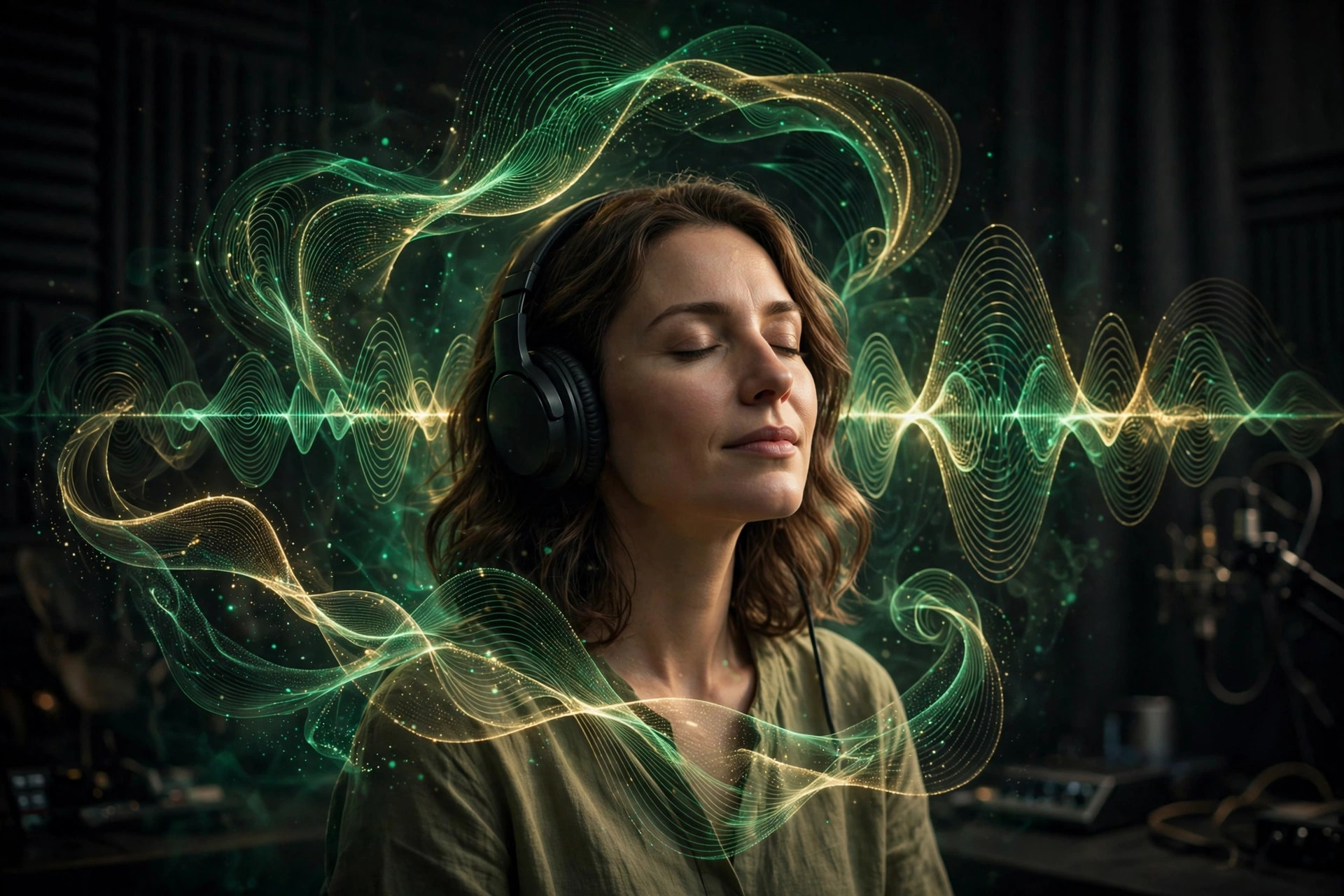
Sound fits into that system at the middle step: attention. Music changes how alert you are, how stressed you feel, and how well you concentrate. Those are the exact mental states that determine whether your visualization session sharpens your focus or dissolves into daydreaming, whether your planning session is creative or anxious.
So the question “what frequency is best for manifestation?” has a better replacement: what sound creates the brain state your practice needs right now? Everything below follows from that reframing.
What the research actually says
No miracle claims here — just studies, their limits, and what they mean for you.
528 Hz and stress hormones. One small study (Akimoto and colleagues, 2018) found that listening to music tuned to 528 Hz lowered participants’ cortisol — the stress hormone — and increased oxytocin, the bonding hormone, compared to a control track. Mood improved too. Important limits: small sample, short exposure, and no one measured anything about goal achievement. It suggests 528 Hz music can feel calming. It does not show it manifests anything. (I go deep into this study in Episode 1 of my FREQUENCY series — “Your Stress Hormones Respond to 528Hz Music — Here’s the Proof.”)
432 Hz vs. 440 Hz. This is the famous “natural tuning” debate: is music tuned to A=432 Hz somehow better for you than the modern standard of A=440 Hz? One study (Calamassi and Pomponi, 2019) found that dental patients felt slightly less anxious hearing 432 Hz music before procedures. But follow-up research has been mixed, and the claim that 432 Hz is “nature’s frequency” has no physical basis — pitch standards are human conventions. If you find 432 Hz tracks relaxing, enjoy them. Just know the benefit is probably the music itself, not the tuning.
Binaural beats. These are two slightly different tones played in each ear — your brain perceives a pulsing “beat” at the difference frequency. A 2019 meta-analysis (Garcia-Argibay and colleagues) found binaural beats can modestly affect attention and memory performance, with the strongest effects in the minutes during listening. But effects vary wildly between people, and there’s no evidence they help anyone achieve a goal. They’re a focus tool, not a manifestation tool.
40 Hz “gamma” stimulation. MIT researchers have been testing whether 40 Hz sound (and light) stimulation affects Alzheimer’s-related pathology in mice — genuinely interesting neuroscience, and early human trials are underway. This is about brain health, not manifestation, and I mention it only to show the honest version of “frequency research”: real, serious, and completely different from what manifestation influencers claim.
The consistent finding across all of this: sound reliably changes arousal, mood, and stress. Relaxed-but-alert states are associated with better creative thinking and sustained attention. No study shows a frequency selecting your outcomes.
How to actually use sound in your practice
Forget hunting for the “right” hertz. Here’s the protocol that follows the evidence.
1. Name the brain state your session needs
Different practices need different states. Deep visualization and creative brainstorming work best when you’re relaxed but alert — roughly what researchers call an alpha-dominant state. Reviewing plans and taking action need sharper focus. Calming anxiety before a hard conversation needs deep relaxation. Pick the state first; the sound follows.
2. Choose audio that creates that state for you
Individual response varies enormously — one person’s perfect focus track is another’s distraction. Ambient drones, lo-fi, nature sounds, binaural beat tracks, or slow instrumental music all work if they reliably settle your mind. Test candidates for a week each and notice which ones you emerge from calmer and clearer. Your data beats any influencer’s recommendation.
3. Anchor it to your practice with implementation intentions
Behavioral psychology (Gollwitzer’s implementation intentions research) shows that linking a behavior to a specific cue — “when X, I will do Y” — dramatically raises follow-through. Use your audio as the cue: “When I press play on my visualization track, I sit down and begin.” Over time the sound itself becomes a conditioned signal that shifts your brain into practice mode. The ritual isn’t magic — it’s habit science.
4. Keep volume low and the same track looping
Variety is the enemy here. A single, familiar, low-volume track fades into the background, which is exactly what you want: stimulation without distraction. Novelty in the music grabs attention; repetition lets the brain settle.
5. Track your state, not your frequency
Here’s the highest-leverage step. Keep a simple log: before each session, rate your stress and focus from one to ten; rate them again after. Two weeks of this data tells you more about “what works for you” than any frequency chart on the internet. The Five Minute Journal is the tool I recommend for this (affiliate link) — three lines in the morning, five at night, and it turns a vague practice into measurable feedback. The journal is the real engine here; the music is just the atmosphere.
6. Reassess after two weeks
If your sessions consistently feel calmer and more focused, keep the track. If nothing changes, change the track — or drop the audio entirely and try silence. The practice produces the results. The soundtrack is optional.
The honest summary
- No frequency has been shown to manifest outcomes. The “best” frequency is the one that reliably puts you into the state your practice needs.
- 528 Hz, 432 Hz, and binaural beats all have some real, small, well-documented effects on stress, mood, and attention. None has evidence for manifestation.
- Use sound as an attention tool and a habit cue — then measure your own results with a short written log.
Sound is a genuine lever on your mental state, and your mental state genuinely shapes your results. That’s the honest, evidence-backed version of the frequency story — and unlike the magic-number version, it actually works.
Frequently asked questions
Is 432 Hz really better than 440 Hz for manifestation? One small study found 432 Hz slightly reduced pre-surgery anxiety; later research is mixed, and the “natural tuning” claim has no physical basis. If it relaxes you, use it — the relaxation is doing the work, not the tuning.
What about 528 Hz — the “love frequency”? A 2018 study found 528 Hz music lowered cortisol and raised oxytocin in participants, with improved mood. That’s a genuine, measured effect on stress — but the study was small and says nothing about manifesting outcomes.
Do binaural beats actually work? A 2019 meta-analysis found modest, short-lived effects on attention and memory while listening, with wide individual variation. They’re a reasonable focus aid; they’re not a manifestation technique.
Can listening to a frequency alone manifest anything? No credible evidence supports that. Outcomes come from attention, decisions, and consistent action — sound can improve the first, which helps the other two, but the soundtrack never does the work alone.
What should I listen to while visualizing? Whatever reliably makes you feel relaxed but alert: ambient tracks, slow instrumentals, nature sounds, or soft binaural beats at low volume. Test one track for a week, log your stress and focus before and after each session, and keep what your own data supports.
Keep going
- Watch: FREQUENCY Ep. 1 — “Your Stress Hormones Respond to 528Hz Music — Here’s the Proof” — the full study breakdown in my weekly neuroscience-of-sound series. Episode 2 (the 432 Hz “natural tuning” debate) drops October 11.
- Try the tool: If you’re stuck on goal clarity, take the What’s Blocking Your Manifestation? quiz.
- Read next: Frequency and Vibration: The Key to Manifesting · How to Do Quantum Jumping Step by Step · Manifestation FAQ
Start your mornings with intention
Manifestation is a daily practice, not a one-time event. The Daily Affirmations app delivers a fresh science-backed affirmation every morning — free, no signup. Pair it with your new listening routine and give your brain the same cue at the same time each day.